CHARLIE KIRK: AN AUTHENTIC WITNESS
In a sermon at Liberty University earlier this year, Alistair Begg preached from Romans 12:1-2 and identified three significant lies challenging today’s youth: that there is no Creator God, that there is no absolute morality, and that there is no absolute truth. This month marks one year since Charlie Kirk, a young leader who courageously opposed those three lies, was assassinated. Kirk was a Christian, but was most often identified as a “conservative activist” because he founded Turning Point USA, a youth organization “committed to identifying, educating, training, and organizing students to promote freedom.”
To identify Kirk solely as a political activist is to whitewash the most important part of his life – his Christian faith, which was also the source of the spiritual and political freedom he championed to students all over the country. Kirk’s faith was so integral to his life that it is the reason he was targeted for death. It is also the reason he should be remembered as an American Christian martyr.
A martyr is defined as “one who, by his death, bears witness to the truth of the gospel,” or one who “is killed or made to suffer because of their religious or other beliefs.” We may not quibble with the idea of Kirk as a martyr for his political beliefs, but hesitate to say that he was a martyr like the biblical Stephen or missionary Jim Elliot. In the plethora of videos available of Kirk speaking with university students, one witnesses his strong faith, his deep understanding of the Bible and its history, and his grasp of the fact that America’s unique founding is inseparable from the gift of liberty “endowed by our Creator.” He was clearly a Christian first.
Kirk was an evangelistic Christian. To an auditorium filled with students, Kirk confessed his hesitancy in the early years of Turning Point USA to speak about his faith.“We should always proclaim ultimate truth,” he said, “that there is a Creator, that we are made in his image – mind, soul, body, spirit – that we are here to connect people back with . . . Jesus Christ as our Lord and Savior.” He went on to share what may have been the impetus for his campus conversations – especially with those who disagreed with him. Conversing or dialoguing is unique to humanity as God’s image bearers, Kirk said. He pointed out that creation occurred with logos, the spoken, rational word of God, and that as image bearers, human beings are made to think and speak rationally. We deny a part of our humanity, he said, when we stop dialoguing.
Kirk connected America’s founding principles of liberty and law to God. In response to a student question about morality, Kirk replied, “We will not save the country just through politics. Politics is a means toward an end – toward liberty. Liberty is not man’s idea but God’s idea. We are only able to experience that liberty if we are a moral and religious people. The Constitution is incompatible with a faithless nation. You will not have a free society if the country goes atheist. You will not have a free society if the country goes secular. Liberty and freedom cannot coexist with a nation that does not believe in a higher power.”
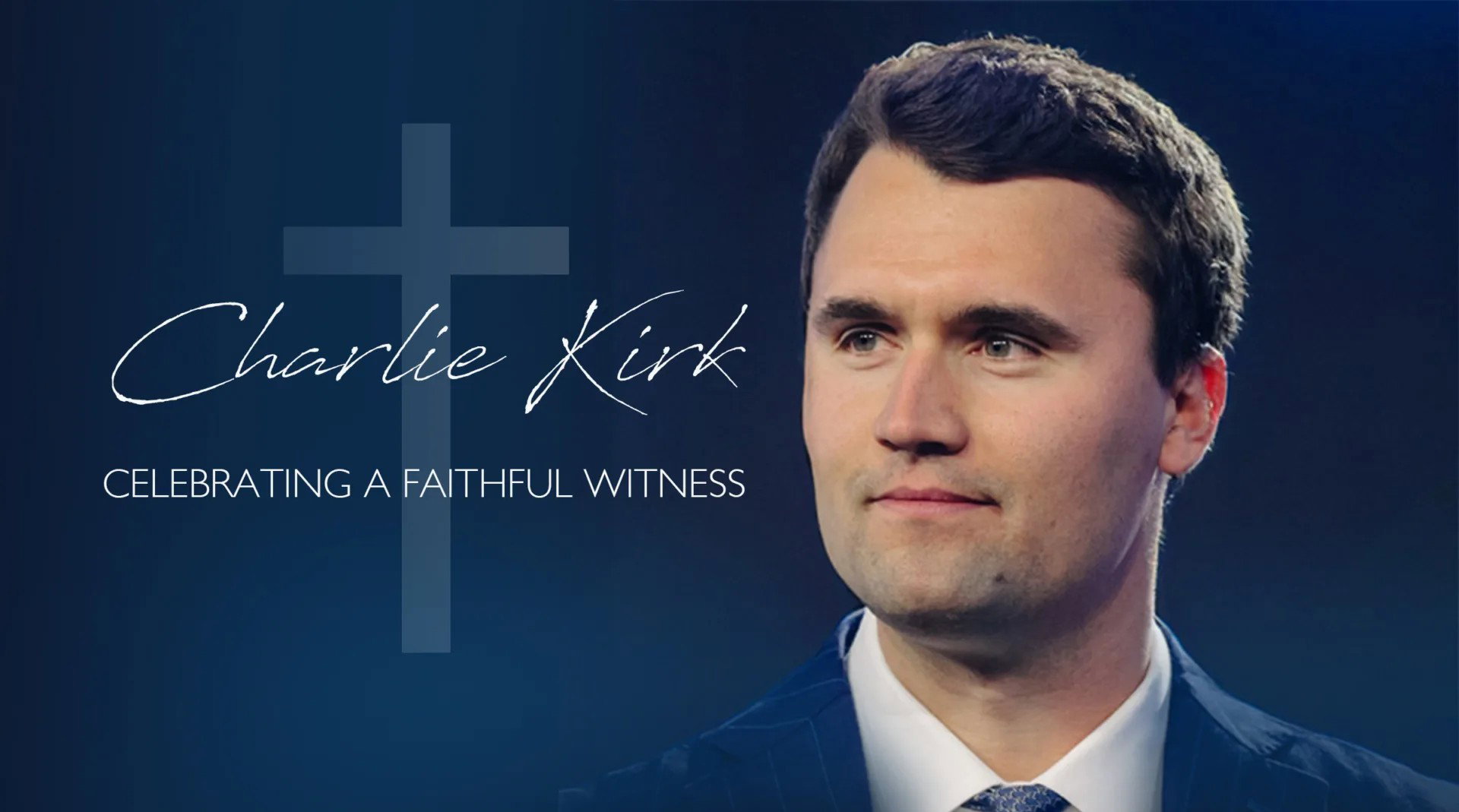
Recognizing Kirk as an American Christian martyr serves at least two purposes. First, as Christians, we want to emulate the steadfast courage and truth of those who died for the faith. Kirk was not conformed to the patterns of this world, and was unapologetic in calling young men and women to the same. In his campus visits, Kirk was respectful and generous to students who disagreed with him, and to many who were abusive. Kirk encouraged young men to live bold lives of faith, to marry, to lead in their homes and churches, and he led by example, marrying Erika and becoming a father of two children.
Second, acknowledging Kirk’s murder as a martyr’s death requires us to see that the evil one is working to silence Christians in the United States. Americans are reluctant to see the U.S.A. as a place where Christians are persecuted, let alone martyred; but we need to accept that while persecution methods may differ, the evil one will always seek to silence truth and those who speak it.
In his 1978 book Christian Counter-Culture, John Stott wrote, “Persecution is simply the clash between two irreconcilable value systems . . . because persecution is a token of genuineness, a certificate of Christian authenticity.” Kirk’s authentic Christian character put him squarely into the cross-section of clashing value systems – and the crosshairs of an assassin. Like the apostle Paul, he leveraged every tool at his disposal, both as a Christian and as a citizen of his country, to defend and promote freedom as a gift from God for the purpose of sharing the Gospel of Jesus Christ, and for speaking bold truths with kindness for the purpose of human and political freedom.
In America’s 250th year, its youngest citizens are desperate for dialogue that guides them to freedom and purpose. America’s youth are also desperate for dialogue that introduces them to Jesus, in whom authentic seekers find true freedom and purpose. We have lost Charlie Kirk – who had respected them, inspired them, spoken truth to them, and given them hope for the future. But we have not lost hope. We have not lost truth. We have not lost Christ. Let us dialogue kindly, wisely, boldly; let us witness authentically.