FAITHFUL FARMERS
My wife and I belong to a rural church in eastern Washington – the First Christian Church of Pomeroy. It seems there’s a farmer in every other pew. Many had parents and grandparents who were farmers. They understand that hard work does not hinder prayer and prayer does not hinder hard work.
As I write, it’s harvest time in our Northwest neck of the nation. Our farmers show up at church exhausted from heavy harvest duties, and prayers go up on their behalf. Last year, an equipment breakdown at just the wrong time was especially challenging for one of our elders. But in a no-nonsense rural way of speaking, he managed.
Another quality in rural churches is that members will drop everything to help meet a need. For example, one grieving sister who recently lost her farmer husband of 62 years began to clean the house of a younger friend who was laid up with a serious injury. I don’t think anyone had to ask her. Things like that were not uncommon. Did I tell you about the potlucks? Words fall short!
With genuine credibility, a young farmer named Tye told me about what his faith and church mean to him. In his work, he said, there are no guarantees. This calls for a solid faith that keeps him in a “God will provide” mindset. Nature is not as predictable as white-collar workers like me may presume. When a famine, flood, fire, or storm wipes out a season’s worth of work, farmers just get back out there and start over. Tye depends on things he cannot control – like the weather, the market, and more. Some jobholders expect guarantees on many levels in their work. Not Tye. A family man, his faith is his ultimate guarantee. Meanwhile, he works hard and prays.
As a boy, I was taught to respect the police. I idolized sports heroes. The focus on missionaries at church elevated that vocation in my mind. I also admired ministers and teachers. Today, my wife makes Quilts of Valor to honor veterans. As one raised in urban churches of Christ, these were a few of the occupations I learned to admire. But what about farmers?
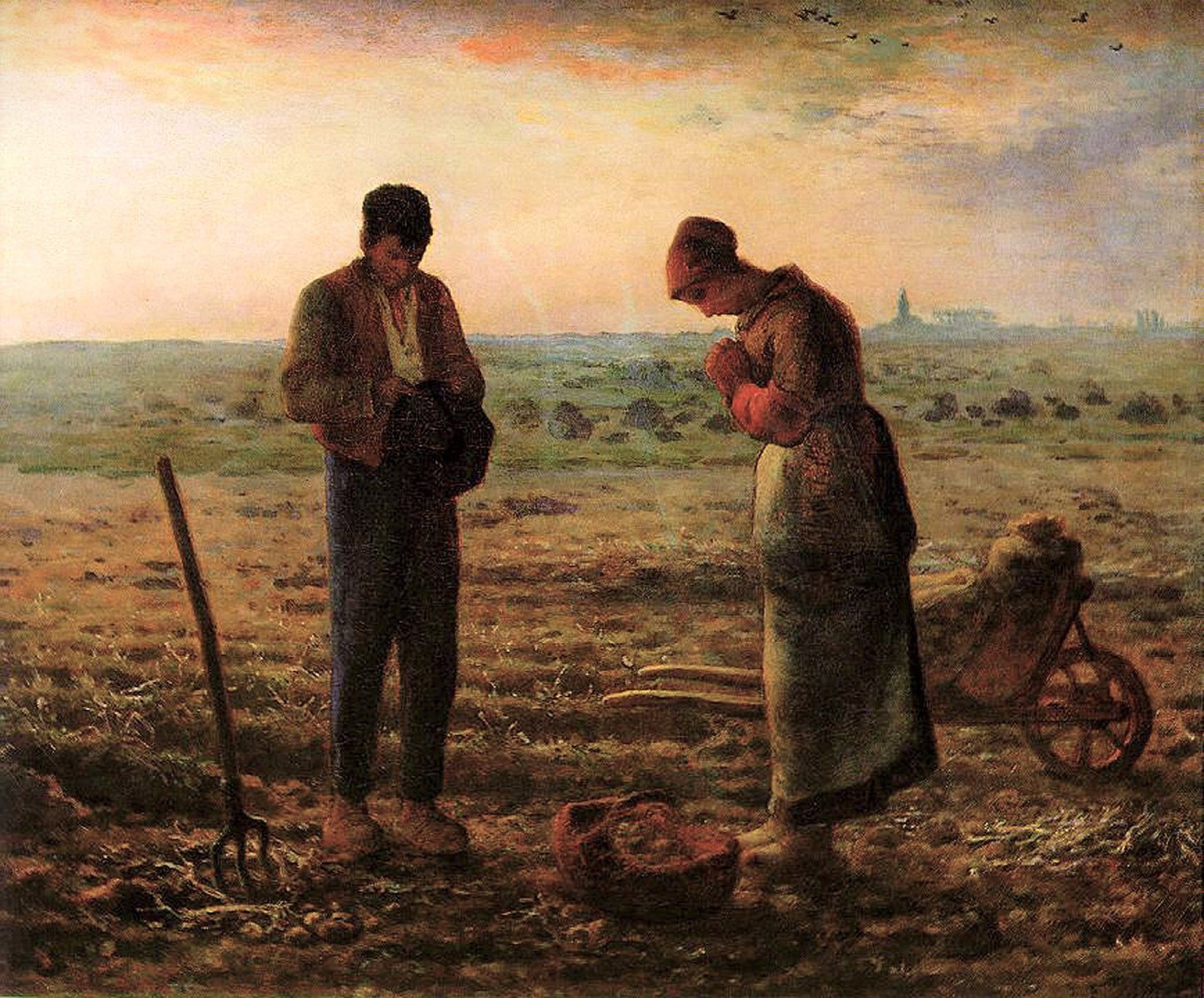
Let me begin my tribute to faithful farmers by featuring a famous painting titled The Angelus (1857-59) by Jean-François Millet (French, 1814–1875). The title referred to the ringing of the “Angelus bell,” which called farmers in the countryside to evening prayers. See the steeple in the distance? It rang daily at 6 a.m., at noon, and at 6 p.m. to call for prayers.
These farmers did not believe in prayer as an alternative to hard work. They have worked all day long, but not too long to stop and pray. They could identify with Sir William Benham’s proverb “Pray devoutly, but hammer stoutly.”
I’ve never heard a disparaging word from Tye. Since I was asking, he added, “There’s a lot of alone time in the fields.” He uses this time to commune with God and nurture his faith. This also deepens his desire for fellowship. He said that church is his main social occasion in the week. The alone times are a struggle, but Tye turns it into an asset.
Does your work make it hard to find time to pray? Consider the couple in The Angelus by Millet. Your work is not the problem. If they can find time to pray, why not you? No resource can help you turn struggles into assets better than approaching the heavenly throne of grace through prayer.